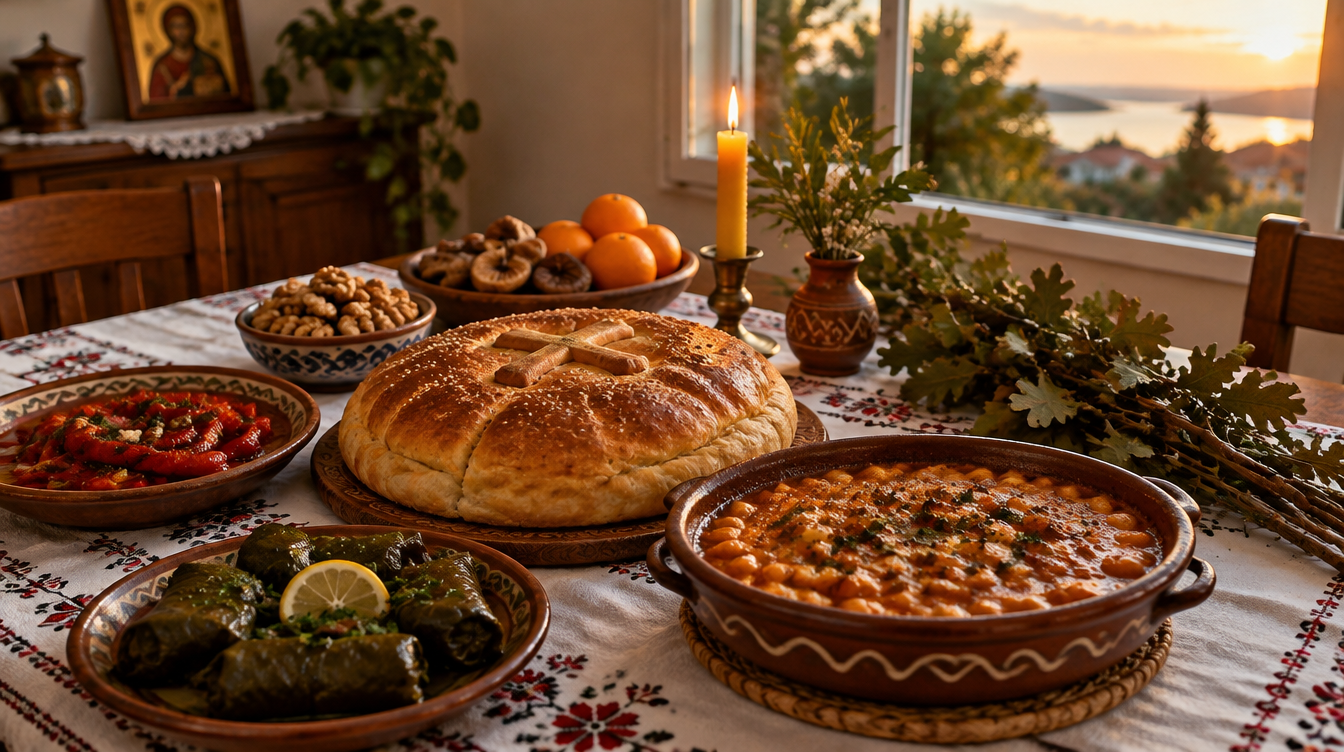
Badnik in Australia: The Oak Branch, the Coin Bread and What to Cook on Macedonian Christmas Eve
Badnik (Бадник) is Macedonian Christmas Eve. It falls on 6 January, the night before Macedonian Orthodox Christmas on 7 January. Families bring home oak branches, share a meat-free dinner and break a round loaf with a coin hidden inside. Whoever finds the coin is said to have luck all year.
In Macedonia, Badnik happens in the middle of winter, often with snow outside. Here in Australia, it lands in the middle of summer, when it can be 35 degrees at dinner time. The customs are the same, but we do them a little differently. This guide explains each tradition, why it matters, and how Macedonian families in Australia keep it alive.
Why is Macedonian Christmas on 7 January?
The Macedonian Orthodox Church follows the old Julian calendar for its feast days. The Julian calendar runs 13 days behind the calendar we use every day. So the church’s 25 December lands on our 7 January, and Christmas Eve lands on 6 January.
Serbian, Russian and some other Orthodox churches use the same dates. That is why you may see other communities celebrating on the same night.
What does “Badnik” mean?
The word Badnik comes from an old Slavic word that means “to stay awake” or “to keep watch”. Christmas Eve was a night of waiting for the birth of Christ. People stayed up, prayed and kept the fire burning through the night.
“Badnik” is also the name of the oak branch or log that families burn on this night. So when your Baba says “badnik”, she might mean the night, or she might mean the wood. Both are right.
The day before: Kolede on 5 January
Badnik really starts the night before, on 5 January. This is called Kolede (Коледе). In many villages, people light big bonfires in the evening. Children go from house to house singing carols, called koledarski pesni. In return, they get walnuts, dried fruit, apples, sweets and sometimes coins.
Some Macedonian churches and clubs in Australia hold a Kolede night with a fire in the churchyard or at a community hall. Check your local church page or our Macedonian events calendar in late December to see what is on near you.
The oak branch (badnik)
On the morning of 6 January, the men of the house traditionally go out and cut young oak branches. The oak is a symbol of strength and long life. The branches are brought into the home in the evening, and the family greets them like a guest. Later, they are placed on the fire or kept near the family icon.
Many families keep a small sprig of oak in the house for the whole year. Some put a few leaves under the tablecloth. Others hang it near the front door for protection and good luck.
Where to get oak in Australia
Oak trees are not native to Australia, but English oaks grow well in cooler places like Canberra, Melbourne, the Adelaide Hills and the Blue Mountains. Here are some easy ways to get a branch:
- Ask at your church. Many Macedonian Orthodox churches bring in oak branches and hand them out after the Badnik service.
- Ask a friend or neighbour who has an oak tree in their yard. A small branch is plenty.
- Call a local nursery or tree lopper. They often have offcuts.
Please don’t cut branches from trees in parks or on the street. Council trees are protected, and you could be fined.
The fasting dinner (posna vecera)
Badnik is the last day of the Christmas fast. The fast lasts 40 days, so the Christmas Eve dinner has no meat, eggs or dairy. It is called the posna vecera (посна вечера), which means “fasting dinner”. Some families allow fish, and some don’t. Follow what your family has always done.
Even without meat, the table is full. Common dishes include:
- Tavche gravche (тавче гравче) – baked white beans in a clay dish. This is the heart of the meal for many families.
- Posna sarma (посна сарма) – vine or cabbage leaves stuffed with rice and onion instead of meat.
- Pindjur and ajvar – roasted pepper and eggplant spreads, eaten with bread.
- Fish – baked or grilled, if your family allows it.
- Walnuts, dried figs, prunes and fruit – to wish for a sweet, plentiful year.
- Zelnik (зелник) – a pastry pie, made with oil and filled with leek, cabbage or spinach.
In some homes, people put a little straw under the tablecloth. It reminds everyone that Jesus was born in a stable. Many families also light a beeswax candle on the table and say a prayer before eating.
A summer Badnik menu
When it is hot outside, heavy baked dishes can feel like a lot. Here are a few ideas that suit an Australian summer and still keep the fast:
- Serve the beans as a cold bean salad with onion, parsley and paprika oil.
- Grill fish on the barbecue instead of baking it inside.
- Put out fresh tomatoes, cucumbers and peppers with salt and oil.
- Use mangoes, cherries or apricots alongside the dried fruit.
The coin bread (pogacha)
The most loved moment of the night is breaking the bread. The bread is a round loaf called a pogacha (погача) or lepche (лепче). Before baking, the cook hides a coin inside the dough. Some families mark a cross or a pattern on top.
At the table, the head of the family breaks the bread by hand. It is not cut with a knife. Each person gets a piece, and in many homes there are also pieces set aside for the house, for the church or for the Mother of God.
Whoever finds the coin is said to have good luck and good health all year. In some families, the lucky person drops the coin into a glass of wine and takes a sip. In others, they keep the coin in their wallet until next Badnik.
If you are making pogacha at home, wash the coin well and wrap it in a small piece of foil. Tell the kids to chew carefully.
Going to church on Badnik
Most Macedonian Orthodox churches in Australia hold a service on the evening of 6 January. Some hold a late-night service too, with the Christmas liturgy early on 7 January. Times change each year, so check with your parish first.
You can find a full list of churches, with addresses and maps, on our Macedonian Orthodox churches page.
Christmas Day: Bozhik on 7 January
On Christmas morning, the fast is over. People greet each other with “Христос се роди!” (Hristos se rodi – Christ is born!). The reply is “Вистина се роди!” (Vistina se rodi – Truly He is born!).
Lunch is a big feast with roast pork or lamb, cheese pies, salads and cakes. For more greetings and card messages, read our guide to saying Merry Christmas in Macedonian.
Keeping Badnik alive in Australia
Badnik is not a public holiday in Australia. Many people work on 6 January, and the kids are on school holidays. Here are some simple ways families make it work:
- Book 6 or 7 January off work early. Many Macedonian businesses close.
- Get the kids to help bake the pogacha and hide the coin.
- Teach them the Christmas greeting before the night.
- Invite Baba and Dedo to tell the story of Badnik in their village.
Every village did Badnik a little differently. If your family has its own custom, we would love to hear about it. Send us your family’s Badnik story, and we may add it to this page.
Frequently asked questions
What date is Badnik?
Badnik is on 6 January every year. Macedonian Orthodox Christmas (Bozhik) is on 7 January.
What do you eat on Macedonian Christmas Eve?
A fasting dinner with no meat, eggs or dairy. Common dishes are tavche gravche (baked beans), meat-free sarma, pindjur, zelnik, walnuts and dried fruit. Some families also eat fish.
Why is there a coin in the Christmas bread?
The coin brings luck. Whoever finds it in their piece of pogacha is said to have good luck and health for the whole year.
What do you say on Badnik?
You can say “Среќен Бадник” (Srekjen Badnik – Happy Christmas Eve). On Christmas Day, say “Христос се роди!” and reply “Вистина се роди!”.
Is Badnik the same as Serbian Badnji Dan?
They share the same date and many of the same customs, like the oak branch and the coin bread. Each country and each village also has its own songs, foods and small traditions.
Further reading: Balkan Christmas traditions (Radio Free Europe) and Macedonian Orthodox Church.
Прочитајте на македонски: Бадник: македонските обичаи за Бадник во Австралија