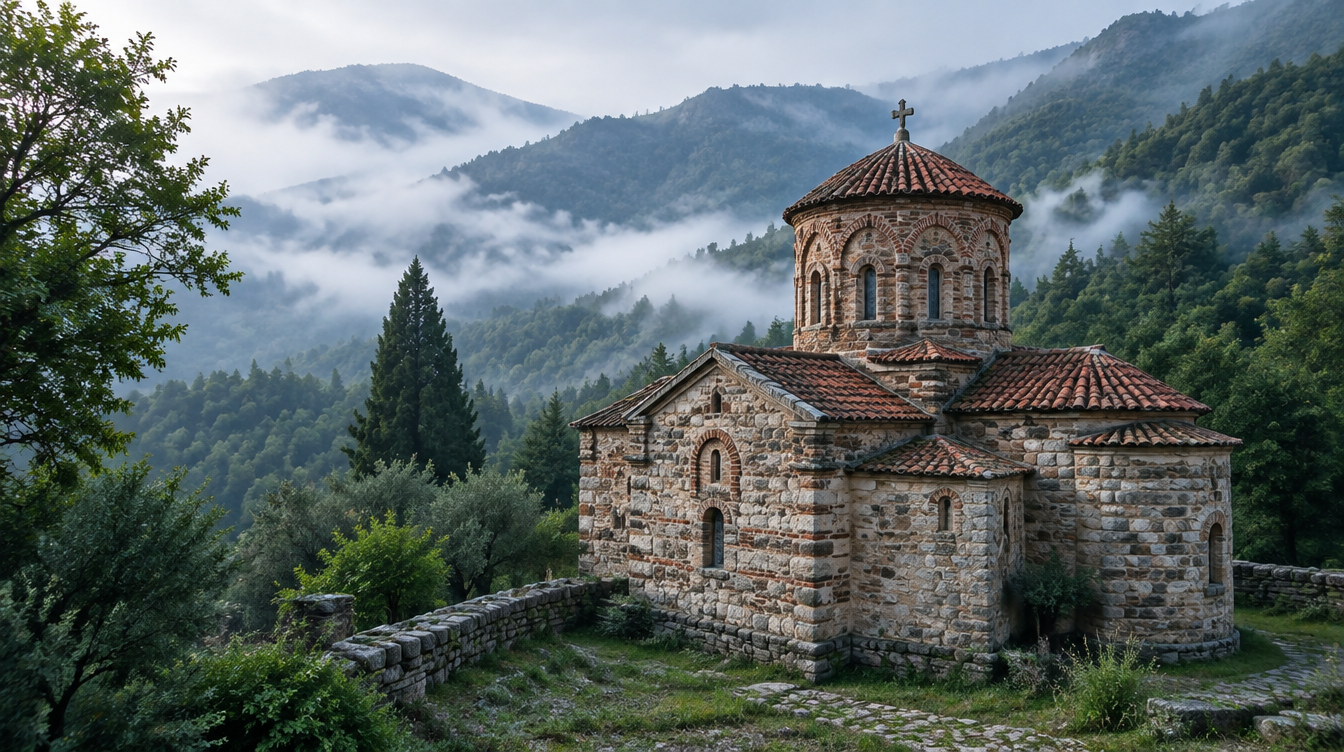
Macedonian Monasteries Worth the Drive: 10 to Visit
The Macedonian monasteries most worth the drive are St Naum and St Panteleimon near Ohrid, and St Jovan Bigorski in the west. Treskavec and Zrze near Prilep, and Nerezi and Marko’s Monastery near Skopje, are also on the list. So are Lesnovo, Osogovo near Kriva Palanka, and the cave churches of Kališta near Struga.
Several go back 600 to 1,000 years, and many hold medieval frescoes and carved iconostases. All of them are on our heritage map, along with 257 more.
Many Australian families fit a monastery or two into a summer back in the village. With a hire car and a free week, you can see the best of them and still be home for dinner most nights.
The 10 monasteries at a glance
| Monastery | Region | Nearest town | Known for |
|---|---|---|---|
| St Naum (Свети Наум) | South-west | Ohrid (about 29 km) | Lakeside setting, tomb of St Naum, peacocks |
| St Panteleimon, Plaošnik | South-west | Ohrid (in town) | Tomb of St Clement, Ohrid Literary School |
| Kališta (Калишта) | South-west | Struga (about 4 km) | Cave church with 14th–15th century frescoes |
| St Jovan Bigorski (Бигорски) | West | Debar / Gostivar road | Carved walnut iconostasis, guest rooms |
| Treskavec (Трескавец) | Pelagonia | Prilep (about 8 km) | Mountain-top setting, Byzantine frescoes |
| Zrze (Зрзе) | Pelagonia | Prilep (about 25 km) | Icon of the Virgin Pelagonitissa (1421) |
| St Panteleimon, Nerezi (Нерези) | Skopje | Skopje | Frescoes from 1164, including the Lamentation |
| Marko’s Monastery (Марков манастир) | Skopje | Skopje (about 18 km) | 14th century church of St Demetrius |
| Lesnovo (Лесново) | North-east | Probištip / Zletovo | Frescoes of 1346–49, Mijak iconostasis |
| Osogovo (Осоговски) | North-east | Kriva Palanka | St Joachim of Osogovo, mountain views |
Around Ohrid and Struga
St Naum
St Naum sits on the southern shore of Lake Ohrid, about 29 km from Ohrid town. Saint Naum founded it in 905 and was buried in the church. The church you see today was rebuilt in the 16th and 17th centuries. Its iconostasis dates from 1711.
Visitors queue to put an ear to the saint’s tomb; local belief says you can still hear his heartbeat. Peacocks wander the gardens, and boats take you out to the springs nearby. There is accommodation in the area, and tour boats also run from Ohrid harbour; check times locally.
St Panteleimon at Plaošnik
This church on Plaošnik hill, in Ohrid itself, stands where Saint Clement built his church and school in the late 800s. Clement taught his students here and was buried here in 916. The church you see now was rebuilt between 2000 and 2002, and his tomb is inside. It is part of the Ohrid UNESCO World Heritage area.
Kališta
About 4 km south of Struga, on the edge of the lake, Kališta is a working convent run by nuns. Climb up to the small cave church of the Nativity of the Virgin, set into the rock above the main church. Its frescoes date to the 14th and 15th centuries.
The west: St Jovan Bigorski
Bigorski sits above the Radika River in Mavrovo National Park, on the road between Gostivar and Debar. Tradition says it was founded in 1020 by Jovan of Debar, an Archbishop of Ohrid. Its great treasure is the walnut iconostasis carved between 1829 and 1835 by Mijak craftsmen led by Petre Filipov-Garkata.
A fire in 2009 destroyed the older wings, but the church survived, and rebuilding began in 2010. Bigorski is one of the few places where you can stay the night; it has dozens of guest beds. Contact the monastery ahead.
Around Prilep
Treskavec
Treskavec clings to Mount Zlatovrv at 920 m, about 8 km north of Prilep. It dates from at least the 12th century and was rebuilt in the 14th. The church holds a large set of Byzantine frescoes.
A fire in 2013 badly damaged the living quarters, but the church was not touched. Getting there means a steep hike up from Prilep, so wear good shoes, carry water and ask locally about road access.
Zrze
Zrze lies about 25 km north-west of Prilep, near the village of the same name. Its church of Saints Peter and Paul has 14th century fresco fragments. The monastery is famous for the icon of the Virgin Pelagonitissa, painted in 1421 by Makarije Zograf. The monks’ old stone cells are believed to be far older than the church.
Around Skopje
St Panteleimon, Gorno Nerezi
This small church in the village of Gorno Nerezi, above Skopje, was built in 1164. Its frescoes are among the most important works of Byzantine art anywhere. The Lamentation, showing Mary holding the dead Christ, is famous for its raw emotion. Art historians point out that it was painted about 140 years before Giotto.
Marko’s Monastery
Marko’s Monastery is in the village of Markova Sušica, about 18 km from central Skopje. Work on its church of St Demetrius began in 1346 under King Vukašin. It was finished around 30 years later, in the time of his son, Prince Marko. Inside are frescoes of the great feasts and portraits of both rulers.
The north-east: Lesnovo and Osogovo
Lesnovo
Lesnovo is in the village of the same name, on the slopes of Mount Osogovo near Zletovo and Probištip. The church of the Archangel Michael dates from 1341, and its frescoes were painted between 1346 and 1349. The carved iconostasis (1811–1814) is the first of four famous iconostases by Petre Filipov-Garkata and his Mijak carvers. In the Middle Ages, Lesnovo was a centre of learning and book copying.
Osogovo (St Joachim Osogovski)
The Osogovo monastery stands on a hill near Kriva Palanka, about 10 km from the Bulgarian border. It was founded in the 12th century and is linked with Saint Joachim of Osogovo. The large church of St Joachim was built in 1851. The monastery has dormitories and guest accommodation, and in summer it hosts an art colony. St Joachim’s feast falls on 29 August, when crowds come for the service.
Visiting etiquette
Monasteries are homes and places of prayer, not museums. A few simple habits make you welcome.
- Dress: cover shoulders and knees. Women may be asked to wear a skirt; some monasteries lend wraps at the gate. Men take off hats inside the church.
- Photos: always ask first. Many monasteries do not allow photos inside the church, and flash damages old frescoes.
- Candles: buy them at the entrance. Light them for the living in the upper stand and for the dead in the lower sand tray, as many Macedonian families do.
- Donations: entry is often free, so leave something in the box. If you stay overnight, ask what is customary.
- Quiet: keep voices low, especially during services. Monks and nuns may not want to be photographed or chat.
Best times to visit from Australia
Remember that the seasons are reversed. Macedonia’s spring (April to June) and autumn (September and October) are the best times, with mild weather and fewer crowds. Many Australian families travel in our winter school holidays, which fall in the Macedonian summer. That is the season of weddings and village feasts, but it is also hot, and Ohrid is very busy in July and August.
Feast days are special. Each monastery celebrates its patron saint with a service and often a big gathering. Check dates on our church calendar. Opening hours vary and change with the seasons, so check locally before a long drive.
Plan your trip with the heritage map
Our heritage map holds 267 monasteries and nearly 2,000 churches. Filter by monastery to see them all, or search a town to find what is close to your village. Each listing has its location, and most have a photo. If your family comes from near one of these places, our guide to tracing your village may help you find the local church too.
Have you visited a monastery that should be on this list? Send us your photos and tips, and we will add the best ones.
Frequently asked questions
What is the most famous monastery in Macedonia?
St Naum near Ohrid is one of the most visited, thanks to its lakeside setting. St Jovan Bigorski is famous for its carved iconostasis.
Can you stay overnight at a Macedonian monastery?
Some offer guest rooms, including Bigorski and Osogovo. Contact the monastery ahead and ask about the rules.
What should I wear to a monastery in Macedonia?
Cover shoulders and knees. Women may be asked to wear a skirt, and men should take off hats in church.
Can I take photos inside the churches?
Often not. Ask first, and never use flash on the frescoes.
Which monasteries are close to Skopje?
St Panteleimon at Gorno Nerezi and Marko’s Monastery, about 18 km away, are both easy half-day trips.
Further reading: UNESCO: Natural and Cultural Heritage of the Ohrid region
Прочитајте на македонски: Македонски манастири што вредат за посета